
Digital Operational Resilience
Service availability, cyber resilience, and incident recovery for always-on financial services across hybrid multicloud
Operational resilience for financial services
Digital sovereignty requirements and regulations such as DORA, NYDFS 500, and APRA CPS 230 have raised the bar for operational resilience, requiring financial institutions to continuously demonstrate service availability, cyber resilience, and rapid incident recovery. F5’s Application Delivery and Security Platform (ADSP) delivers defense-in-depth security across hybrid and multicloud workloads, supports digital sovereignty requirements, and reduces concentration risk.
Minimized revenue impact from downtime
Keep payments, core banking, and digital channels available during cloud outages and infrastructure failures with active-active architectures, intelligent traffic steering, and automated failover across datacenters, regions, and clouds
Reduced concentration risk
F5 ADSP enables hybrid and multicloud architectures that eliminate single-provider dependency, keeping critical banking and financial services infrastructure available when any one provider fails
Resilient security
AI powered security controls that adapt to evolving cyber-threat, unified visibility and logging reduce mean time to recover and support incident reporting requirements.
Regulatory compliance
Regulations such as DORA, NYDFS 500, and APRA CPS 230 require financial institutions to provide evidence of operational resilience. F5 ADSP provides the control plane and audit trail that simplifies DORA compliance and regulatory reporting.

F5 ADSP delivers digital operational resilience
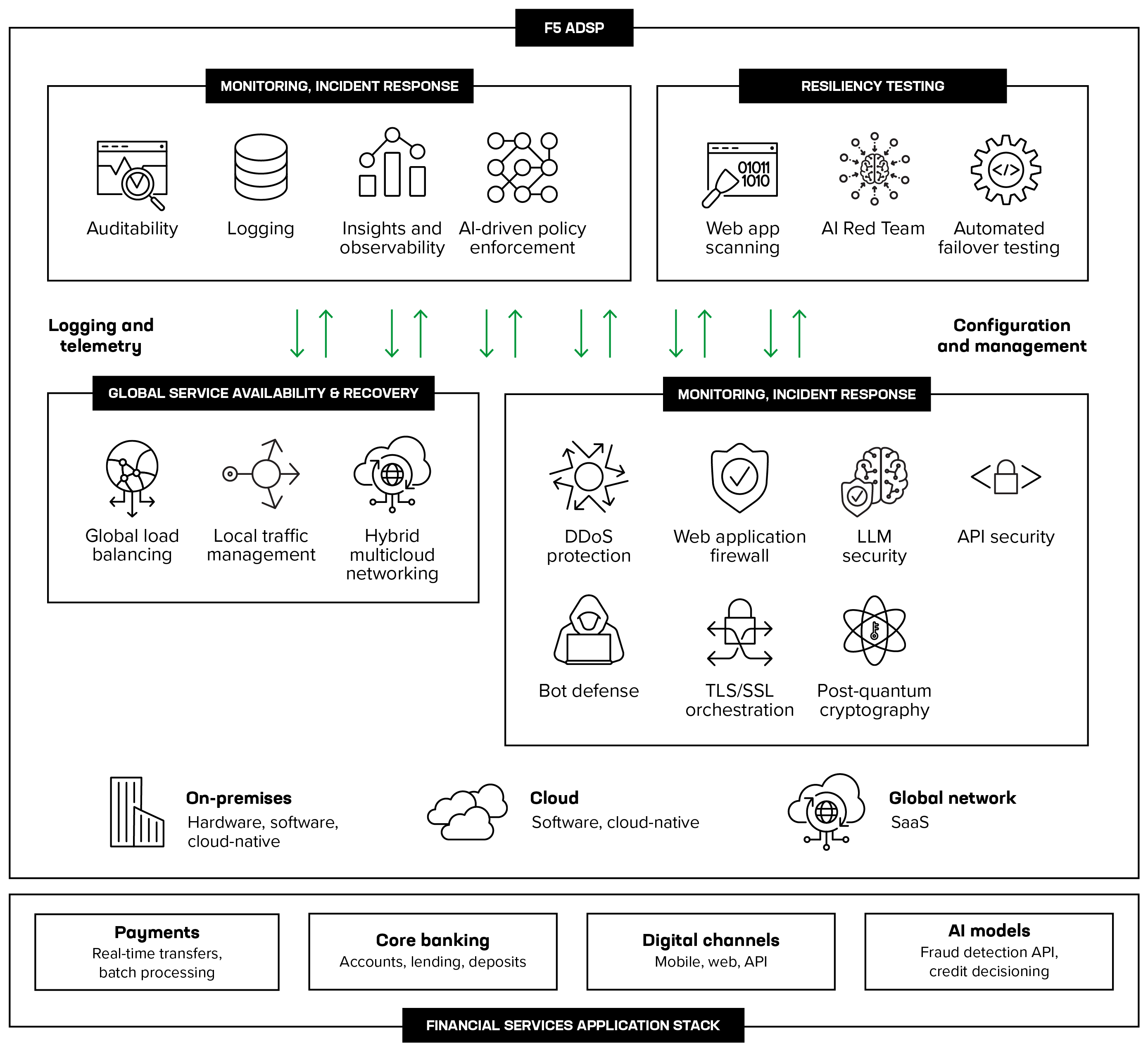
Keep critical financial services available and secure
F5 ADSP delivers and secures critical financial services applications across on-premises, private cloud, and public cloud, eliminating concentration risk and enabling continuous resilience.
Explore enterprise application delivery reference architecture ›
How F5 Helps
Service availability and recovery
High availability for critical financial services
Active-active architectures with intelligent traffic steering and automated failover across hybrid multicloud environments keep payments, core banking, and digital channels available during disruptions.
Global server load balancing
Ensure financial services remain reachable during regional outages
Intelligent traffic management
Optimize traffic distribution to maintain availability of critical financial services applications
Hybrid multicloud networking
Securely connect applications and services across multiple clouds, on-premises, and edge sites
Threat protection and prevention
Stop threats without compromising service availability
Volumetric attacks, application vulnerabilities, and API abuse threaten operational resilience. Protect and prevent threats to financial services infrastructure with layered security controls and post-quantum cryptography readiness.
DDoS protection
Defend against volumetric attacks before they impact financial services availability
WAF
Protect financial services applications and APIs from OWASP Top 10 vulnerabilities and layer 7 exploits
API Security
Centralize encrypted traffic management with quantum-safe encryption across financial services infrastructure
SSL / TLS orchestration
Centralize encrypted traffic management with quantum-safe encryption across financial services infrastructure
Bot defense
Stop automated attacks targeting banking applications, login portals, and customer-facing services
AI Guardrails
Enforce runtime protection for AI models and agents against OWASP Top 10 LLM vulnerabilities
Resilience testing
Validate resilience across applications, AI models, and failover scenarios.
Regulations require financial institutions to continuously test critical infrastructure and processes to demonstrate resilience and recovery. F5 enables continuous scanning, adversarial AI testing, and automated failover validation across hybrid multicloud environments.
Web app scanning
Continuously scan FinServ applications and APIs for vulnerabilities
AI red teaming
Simulate and test adversarial attacks including prompt injection and model manipulation
Automation
Automate failover and test resilience validation across hybrid multicloud environments
Synthetic Monitoring
Monitor response time by region in real time identifying outages & availability issues before customers experience them
Monitoring and incident response
Detect, respond, and recover faster across hybrid multicloud
Siloed monitoring and manual processes slow incident detection, creating regulatory exposure. Unified visibility, AI-driven remediation, and comprehensive logging reduce mean time to recover and support incident reporting obligations.
Unified Management and Automation
Manage policies across hybrid and multicloud environments from a single control plane.
F5 Insight for ADSP
Real-time telemetry and observability across financial services applications and infrastructure.
AI remediate
Automatically convert red team adversarial findings into validated AI runtime guardrails.
Ecosystem integrations
F5 works with many of the world's leading technology companies to improve manageability, strengthen security, and ensure the operational resilience of critical financial services infrastructure.









Resources
FEATURED

Banking on resilience in the AI era
Banks are rethinking resilience, modernizing platforms, and preparing for always‑on, AI‑powered services.
eBooks and webinars
Banking on Resilience: Building a Resilient, Intelligent Bank in the AI Era ›
IT Leader playbook: 10 steps to building resilience ›
Whitepaper: Cyber resilience in the hybrid multicloud enterprise ›
Agentic AI in banking: Scaling AI systems securely in financial services ›
Blogs and articles
Global Resiliency: Safeguarding critical infrastructure amid cloud outages ›
Resilience requirements are reshaping technology strategy ›
Understanding the EU's DORA regulation for financial services ›
Maintaining F5 BIG-IP's golden compliance configuration ›
Build resilience against tomorrow's threats with PQC readiness ›
Post-quantum imperative for financial institutions ›
Customer stories
TOM Bank scales across hybrid multicloud with data sovereignty ›
Affin Bank scales with consistent high availability ›
Frequently asked questions
The F5 Application Delivery and Security Platform (ADSP) helps mitigate cloud service provider (CSP) concentration risk by running the same delivery and security controls on every provider, which makes it practical to run an application on more than one cloud. This supports active-active architectures and failover across cloud providers, helping organizations meet two key DORA operational resilience requirements for ICT services supporting critical or important functions: tested exit plans and concentration risk assessments. Because the controls travel with the application, adding or leaving a provider doesn’t mean rebuilding the delivery and security layer.
Operational sovereignty is an organization’s capability to independently manage, operate, and govern its digital systems and services. This framework ensures an enterprise can migrate workloads, change cloud providers, and maintain business continuity entirely on its own terms without external vendor lock-in. Data sovereignty dictates the physical location where data is stored, who can access it, and the specific legal jurisdictions and regional compliance laws that govern it. Crucially, maintaining localized data residency does not automatically grant an organization total operational control over its digital infrastructure. F5 sees digital portability as a key to unlocking operational sovereignty, which in turn strengthens operational resilience.
Four pillars define resilient AI services like agentic banking workflows: availability, security, testing, and observability. To ensure availability, F5 global server load balancing reroutes traffic if a cluster or region fails. For security, F5 AI Guardrails checks prompts and responses for injections and sensitive data. Resilience testing relies on F5 AI Red Team for adversarial trials and F5 AI Remediate to deploy runtime guardrails. Finally, observability is achieved through F5 Insight for ADSP, which consolidates BIG-IP telemetry to catch system anomalies early.
The F5 architecture limits lateral movement and contains the blast radius of a security breach by combining network segmentation at the infrastructure layer and zero trust policy controls at the application layer. This dual-layer defense isolates compromised assets and restricts unauthorized data paths. At Layers 3 and 4, F5 network firewalls enforce stateful, network-level security policies across inline network segments, while route domains isolate routing tables to establish strict boundary separation between multi-tenant environments. At layer 7, F5 WAAP solutions apply context-aware application and API security policies to explicitly authorize or deny application-to-application and client communications based on continuous verification.
Application and security policy portability enables operational sovereignty by allowing an organization to freely move workloads across environments without having to rewrite policy or rebuild the secure architectures. This decoupling prevents cloud vendor lock-in and maintains consistent compliance posture across hybrid infrastructures. Rather than locking controls into a single cloud provider’s native ecosystem, F5 ADSP standardizes traffic, WAF, API protection, and access policies at the application layer, so the same configurations and policies apply on premises, across public cloud, and in air-gapped environments. Note: While security and delivery configurations are fully portable, application state and underlying data structures must still be accounted for in a broader migration plan.
F5 ADSP continuously monitors application health and reachability. If a cloud region, availability zone, or provider experiences an outage, DNS automatically stops pointing users to the failed site and shifts traffic to healthy backup instances or alternative clouds. This automated, DNS-level failover pairs with global traffic steering so end users experience zero-touch recovery during severe infrastructure disruptions. Simultaneously, high-availability configurations allow active session data and configuration settings to replicate continuously across the platform, ensuring the standby site can pick up traffic immediately without losing established connections. To sustain this posture over time, F5 recommends building antifragile resilience strategies that expand the scope of recovery from simply bouncing back to learning fast and getting stronger, turning inevitable multi-cloud disruptions into a driver of architectural progress rather than an operational tax.
F5 ADSP mitigates third-party ICT risk and supports DORA Article 8 compliance by acting as a defensive abstraction layer between a financial institution's core systems and external networks. Rather than relying on static vendor lists, F5 addresses DORA requirements across three concise operational vectors:
• Continuous Interdependency Discovery (Article 8): F5 utilizes advanced machine learning and real-time traffic analysis to automatically discover and map all active API endpoints. This dynamically brings shadow and zombie APIs into an automated inventory, supporting the mandate to document all ICT assets and external interconnections.
• Vulnerability Control & Schema Validation: The platform shifts security from reactive to proactive by using integrated automated testing (via Heyhack/Wib) to find flaws in APIs before they reach production. It learns OpenAPI specifications from live traffic to enforce a positive security model, instantly blocking schema violations and third-party data leakage attempts.
• Immediate Inline Isolation: To contain the blast radius of a compromised third party without altering network topologies, F5 pairs passive discovery with immediate Layer 7 inline enforcement. Suspicious behavior from external entities is blocked or rate-limited at the perimeter before it can exploit core backend infrastructure.
By leveraging flexible deployment models (SaaS, self-managed NGINX, and air-gapped Local Editions), F5 provides cross-boundary visibility, discovery, and protection across hybrid and multi-cloud environments.